
Votre panier est vide



Like any sport, motocross racing can pay top dollar to champions, which makes it an attractive option to amateur riders ready to move up in their career. But your income will depend on several things, and if you’re not in the right place at the right time, you may miss out on much of the earnings.
The top motocross riders can earn several million dollars per year with sponsorships and endorsement deals and more if they can place in the top spots.
To learn more about the different streams of income that motocross riders try to tap into then keep going to discover how you can get paid as a professional motocross rider.
Motocross riders get their income from several sources, including salaries and sponsorship deals through bike manufacturers like Honda, Kawasaki, KTM, and Yamaha. If a rider is talented and earns the top spot on a preferred bike several events in a row, they stand to make much more money than the rider who finishes 2nd or 3rd place.
When a rider wins the championship for the season, some factory contracts pay a big championship bonus on top of salary. Racer X columnist David Pingree estimated in 2018 that a 450 title bonus at the top end was about $1 million. Contracts are private, so treat that as an estimate, and don’t confuse it with the SMX championship check below, which the series pays.
This article covers AMA Supercross, Pro Motocross, and the SMX playoffs. Freestyle (FMX) riders and MXGP racers in Europe are paid differently, and reliable pay figures for them are hard to find.
The biggest public payday in the sport is now the SuperMotocross World Championship (SMX), which links Supercross and Pro Motocross and finishes with three playoff rounds. The series promotes a $10 million purse across the season, which includes the championship fund. In 2026 the 450 champion, Jorge Prado, collected $1,000,000 from the championship fund and the 250 champion, Levi Kitchen, collected $500,000, with the top 22 riders in each class paid from that fund, according to Racer X. Playoff race money is paid on top of that and is separate from any bonus a rider’s own team pays.

Each race has a “purse,” or pot, of money that is divided among the racers according to their place. The first place gets the largest share, while the rest of the spots are given a smaller percentage of what’s left, with the last place getting the least amount of the purse.
For example, in the 2015 and 2016 AMA Supercross seasons, the total 450 main event purse was worth $66,950. The winning racer got $12,000 of that purse as the first prize. The 2nd spot racer got $6,000, and the rest got a smaller amount, which decreases as it goes down to the last spot. With 22 racers in the main event, the last spot racer received $1,415 for that race. In 2023 and 2024 the 450 Supercross winner’s check was about $14,000, and a 250 win paid about $6,000. Pro Motocross pays by moto instead, and a 450 moto win paid about $3,000 in 2024. Promoters set these purses each season, so treat them as recent examples, not a fixed rate.
Therefore, to earn top dollar from the purse, a rider must place 1st or at least 2nd. If a racer consistently falls to the lower spots, they often have other jobs to support their racing passion. Luckily, there are other sources for pro riders to create an income for themselves.
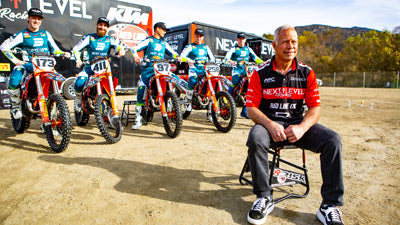
When a manufacturer signs you, you’re part of their racing team, and each rider is paid under his own contract. Riders have been paid in 12 equal monthly installments, plus bonuses for winning and championships, and travel reimbursements.
Most sponsored riders are provided at least two bikes to use; a race bike and a practice bike. The race bike is the one that gets factory-tuned by the company and only makes appearances on race day. Professional mechanics are on-site during the race to do general bike maintenance throughout race day.
The practice bike is for you to get seat time in preparing for race day. That way you (and the Sponsor) don’t have to worry about the practice bike being ‘race-ready’ on the big day and you can just concentrate on honing your skills. Often, the team transfers the title of the practice bike to the rider.

Top racers are also requested to endorse products from various companies. The amount of money they earn is negotiated between the company and the agent, but there is no standard payout for endorsing products. A racer may be required to appear in commercials or at several events in rapid succession.
A famous racer may earn a lot from product endorsements, as long as it is for the team or approved by the team. If the endorsement that a rider makes is for a competing brand, he is at risk for breaching the contract and being fined, or fired.
Factory contracts have typically required riders to be available up to 35 days out of the year to promote the company through autographs, corporate events, or commercials. If a rider does not comply, the penalty is a fine.
Privateer riders aren’t tied to those team obligations, as long as they fulfill the terms of their individual sponsor deals.
Prize money is not the only race-day pay. Manufacturers also post contingency money, a payout from the bike or product brand for riders who race their equipment and finish well. Contingency rules differ by brand and are set before the season, and factory riders don’t receive it, so it matters most to privateers. Factory riders get private win bonuses from their teams instead.
The purse payout is the prize money that is split between all riders at the end of the event. First place earns the top prize amount, while 2nd and 3rd place racers earn significantly less. Companies watch who wins or places in the top five as they will then contract with them for endorsement opportunities in the future. Placing near the top in each race opens up more opportunities for additional income sources.
Where racers place in races determines how much they make from the purse each year. In a 2015 Motocross Action model, a racer who finished tenth at all 17 Supercross rounds would have earned about $52,700 from the purse and the season points fund. A racer who finished in first place at every round would have made about $205,000 in purse money alone.
But this doesn’t take into account the salary, bonus, and sponsorship money that factory riders receive. Purse money alone rarely tops a few hundred thousand dollars a season. The exception is the top of the SMX standings, where in 2026 the championship fund paid $1 million to the 450 champion and $500,000 each to the 450 runner-up and the 250 champion.
That same 2015 model showed how fast bonuses stack up. Adding assumed factory bonuses of $100,000 per win and $1 million for the title, plus a $100,000 points fund payout, pushed a perfect season past $3 million. Those bonus numbers were illustrative, not published rates, and no one won every round that year.
In that same example, a racer that finishes fifth gets over $51,000 in purse money, then about $16,000 from the season points fund. Some riders have team bonuses set up specific to their skill level and finishing place.

Factory teams are teams of riders who race for bike manufacturers. Pingree put the top 450 riders on low seven-figure contracts including bonuses in 2018, with a very good year worth two or three million dollars. Exact figures are not public. Most racers earn significantly less than that and are not free to negotiate their private deals with competing businesses for endorsement deals.
Factory team riders can also make more money than privateers because they draw a salary and team bonuses on top of their race earnings, and the team covers the bikes and mechanics.
Motocross Action reported in 2019 that most big-name factory riders had salaries in the range of $20,000 to $100,000 per month before taxes. Lower level and satellite team riders earn less. Some racers want to be on factory equipment so bad that they will take drastic pay cuts, or even ride for free.
While racers on a team don’t need to buy their bikes to compete or practice, they are responsible for their medical care, and insurance, which cuts into their salaries. As independent contractors, they are also responsible for their income taxes.

Should a racer breach the contract, some contracts have let the team end the deal on five days’ notice. They can also be fired for any felony the rider commits while under contract. Fines are written into some contracts as well; one team’s maximum was $25,000 per violation, while another’s was far lower.
If a rider does not make himself available for events promoting team bikes and other merchandise, or be available to autograph signing events, for up to 35 days per year, he could be fined.
Even with all the team’s control over the rider and his career, the rider has generally been classed as an independent contractor rather than an employee. A racer must buy their health and accident insurance, pay for any emergency room costs, and are not paid any workman’s compensation. They are also responsible for their expenses not related to travel.
However, the team provides a professional mechanic during races for each of the riders. Racers are also given a practice bike, along with the title, so they can keep in shape and keep their skills active. While riders don’t have insurance through the team, they do have other benefits that may outweigh the drawbacks of racing with a team.
Some riders prefer to compete on their own because they can control their careers and off-time compared with being on a factory team. When riders are on a team, they can’t do certain things without breaching part of the contract.
But when riders are on their own, they have the freedom to do what they want within certain limits. These riders are called “privateers,” meaning they are not factory team racers. Their earnings are often limited to prize money and contingency, and most make a modest living at best. For a sense of scale, one special event, the 2026 Yamaha PulpMX LCQ Privateer Challenge, paid $23,650 to its winner. However, if they are talented enough and gain the attention of certain companies, they might become celebrity endorsers for products.
Riders get bonuses from several sources, including their team’s contract bonuses, the series points fund, and sponsors who display their logos on the bikes. A privateer racer can contract with a few sponsors to display their logos on a bike during races. Each bonus then contributes to the overall earnings per race.
Published race earnings only show part of the picture. In PulpMX’s 2026 tally of event payouts plus contingency, champion Jorge Prado collected $1,255,450, and $1,175,000 of that came from the SMX playoffs. The rest came from Supercross and Pro Motocross race money.

There is no meaningful average annual salary for motocross racers, because the sport is top heavy and contracts are private. Many racers find that they can make a lot more money through salaries, endorsements, team bonuses, and other promotional activities than from the purse. Put together, the top earners make far more than the purse alone.
By race money, Jorge Prado was the highest paid rider of 2026. These PulpMX totals count event payouts and manufacturer contingency across Supercross, Pro Motocross, and the SMX playoffs (factory riders get no contingency, so for them it is event payouts alone). They leave out base salaries, private factory bonuses, and sponsor pay, so a factory rider’s real income is higher.
Those 2014 figures were reported by Red Bull at the time as purse plus bonus earnings, not total income. They came before the SMX playoffs existed, when even a perfect season of 450 Supercross wins paid around $205,000 in purse money, so most of a star’s income came from factory salaries and bonuses.
The SMX playoffs create a huge payday for the riders at the top. Further down, race money falls off fast: in the same 2026 tally, riders ranked around 25th to 30th collected roughly $74,000 to $84,000 in race money for the whole year. For factory riders, salary and contract bonuses make up the rest.
If a racer finishes dead last in every race, they may not be able to afford all the expenses that come from racing in motocross events. Costs may range from buying and maintaining a dirt bike to buying gas for the motorcycle to miscellaneous expenses like food and lodging while going to events during the racing season.
And what about tax time? Can you write off these expenses on your tax returns to lower your tax bill? In one case covering 2005 and 2006, the court did not allow the petitioners to deduct about $58,000 of losses over the two years because it was declared an activity not engaged in for profit.

If you don’t ride for a factory team, you need to buy a dirt bike, and a used one costs a lot less than new. For the full breakdown, see our guide on how much it costs to race motocross.
Once you buy your bike, there are the added costs of maintenance, repair, storage, and transportation to and from events. Bike maintenance includes regular oil changes, air filter, and oil filter changes, and tire maintenance.
If you ride for a factory team, the bike that you use in races is professionally maintained by the team, but if you’re riding as a privateer, you need to figure in maintenance costs before, during, and after the race.
Any maintenance costs eat away at your prize money, and if you place low in any race, you may end up paying more for racing than you earn.

You will need gas for your bike and the vehicle you use to transport your bike to racing events. Many bikes run on premium pump gas, and a 2-stroke that uses pre-mix needs oil added to the fuel, which will cost extra money. Check your owner’s manual for the right fuel and octane for your bike.
Now, if you’re going to several races during the season, you’re also spending quite a bit of money on gas for your vehicle, and if you don’t get good gas mileage, you’re burning up all your potential prize money. It would be wise for you to get a fuel-efficient vehicle that can carry a bike trailer.
Membership in the American Motorcyclist Association (AMA) and local clubs have yearly fees that you need to consider. Most of the time, the fees are reasonable, but if you’re racing in several classes, the entry fees add up across the season.
If you’re making the money that top earners make, race and membership fees are nothing to worry about. But if you’re only getting a small payout per event or less, those fees will come from other sources, such as your job, assuming you have a job outside of your racing hobby.

The AMA requires a full-face helmet with a recognized safety certification, and the better helmets cost more. While there are cheaper dirt bike helmets available, not all are safety-certified and may not qualify in a race. The AMA has certain gear standards that you must adhere to, or you will not be able to ride. The helmet cost should not be skimped on as it protects your biggest asset, your head and neck.
Boots are another expensive part of your gear that should not be skimped on because they are made specifically to protect your feet, ankles, and calves from any rocks that fly up or keep your ankle from getting crushed in a crash. Quality boots cost noticeably more than entry-level boots, which you may not have the funds for immediately if you don’t race for a factory team.
The AMA also requires goggles or a shield and chest and back protection, and many riders add knee braces, elbow pads, and a neck brace to help keep their body safe while navigating those twists, turns, and jumps. The gear can add up and eat away at your prize money.
Besides the expenses already discussed, you will also incur many other expenses while traveling to and from races throughout the season. Expenses such as meals, lodging, bike repairs on the road, and any vehicle or trailer repairs that need to be done while traveling can add up and cost you more than you may win in a race. Camping costs might also be a factor if you have an RV or a tent.
Should you not budget for these expenses, or should something come up that you didn’t plan for, you might go into debt if you don’t place high in a race.
In a Tax Court case covering 2005 and 2006 (Paquin v. Commissioner), a couple started a motocross racing sponsorship in 2004. While they didn’t get into racing personally, they decided that they were going to sponsor a team that included their son and other experienced riders. The petitioners, i.e., the couple, would pay the racers’ entry fees, maintain their motorcycles, and take them and their bikes to and from race events in exchange for 75% of the prize winnings of the riders.
The couple thought they would recover their investments in their racers when they became professional riders. Still, they were unable to reach an agreement with the riders about professional earnings, and the riders never reached that status and stayed amateur racers. At AMA sanctioned events, only A class riders can race for cash, and lower classes race for trophies and merchandise.
The petitioners did not create a business plan, did not figure out if they needed a business license, or open a separate business checking account. They also failed to keep accurate records of the fees incurred for the races or other expenses. After the IRS disallowed losses of $57,986 over 2005 and 2006, the couple took the case to Tax Court.
The court decision was in favor of the IRS because the petitioners did not show that they were engaged in any profit-making activity and did not provide accurate information. Their activity was treated as a hobby, and they were charged penalties.
Whether racing expenses are deductible depends on whether you are really in it to make a profit and whether you keep accurate records. If you treat racing as a hobby, don’t count on deducting it.
Be sure to consult a tax attorney or your tax advisor before you claim any expenses on your taxes, or you may end up being investigated by the IRS.

The top professional motocross riders can earn millions of dollars if they are talented and land the right deal, and the SMX playoffs now put a $1 million check on the line for the 450 champion. Most pros never see numbers like that, though, which is why being in the right place at the right time, on the right team, matters so much. A team can provide consistent income, even in the off-season, while racing privately earns the racer money only during the racing season.
Should you decide to go pro, weigh your options before deciding to race with a team, or go out on your own. Many opportunities to make a lot of money exist, but you need to know how to get it without breaching any contracts.
 How Much Does it Cost to Race Motocross?
 How Do I Start a Motocross Career?
 Can You Make Money in Motocross and is it a Career?
 Do You Need Insurance for Motocross?


Les commentaires sont approuvés avant leur publication.

Be in the know! Subscribe for exclusive offers, product launches, and insider tips. Don't miss out!






























Risk Racing
mars 29, 2022
Paige, thanks for the comment. The moto community is an amazing group of people. Like-minded and passionate people! We hope you have a long and successful racing career.