
Your Cart is Empty
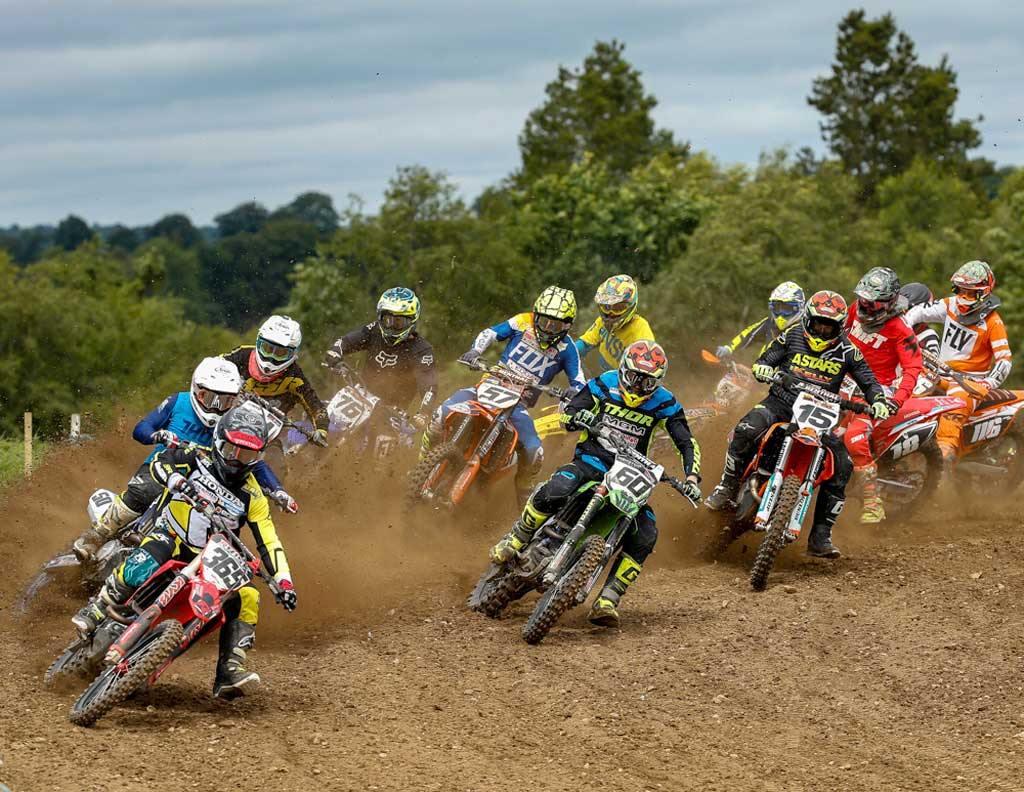

Whether you are thinking about starting MX racing or watching motocross and supercross on TV, you are going to need to know the different categories and classes so that you can follow along with the action.
Motocross racers are divided into many different classes to put similar racers together and create equal opportunity. This is done primarily by the size of the engine in the dirt bike and by the age of the rider. Some of the larger classes are further broken down into ability levels of A B C and D.
For some explanation of the different ways racers are broken down into classes, check out the next section. However, if you are just here for some hard data about the class names in specific race series, then just scroll ahead to the tables.
These are the pro classes you will see on TV in the United States. Pro Motocross runs outdoors in the summer, Supercross runs in stadiums from winter into spring, and the SuperMotocross World Championship (SMX) playoffs combine both.
MX is short for motocross, raced on outdoor tracks, and SX is short for supercross, raced on tracks built inside stadiums. The 250 Supercross class is split into West and East regions. For the full comparison, see our motocross vs supercross guide.
|
Motocross Classes |
Supercross Classes |
SuperMotocross (SMX) Playoffs |
|
450 MX |
450 SX |
450 SMX |
|
250 MX |
250 SX West & 250 SX East |
250 SMX |
|
Women’s MX (WMX) |
No women’s class |
No women’s class |
Motocross/Supercross Number Plate Color Classifications:
On TV, the plate color tells you a pro rider’s class: white for 450, black for 250, and red for the points leader. The yellow plate is for amateur B riders.
|
450 Class (Pro) |
250 Class (Pro) |
B Class (Amateur) |
Current Points Leader (Pro) |
|
White with black numbers |
Black with white numbers |
Yellow with black numbers |
Red background with white numbers |
 |
 |
 |
 |

Imagine for a moment that you are an established track owner and race promoter and you are going to hold a major race. You are expecting hundreds of racers to show up for this event and you know that it will bring in a very diverse crowd of riders.
You will have the 4-17 year old demographic that wants to be the next Eli Tomac or Ricky Carmichael and are probably ripping anything from a 50cc up to a 250F. Even though these riders have the same goals, and potentially some share similar skill levels, it is not logical to place them in the same class.
A racer's abilities are categorized by using a scale of A, B, C, and D.
The naming conventions used above aren't as important as remembering that the A designation at the end of a class means that’s the best of that engine/age class and everything after A is progressively easier. Some races do not have enough riders for both a C and D class, which results in combining the classes and the C class becomes the beginner class.

As we’re already on the topic of class variation and add-on designators I should mention you will also see words like ‘limited’ added onto the back of some classes. Limited means that you are required to keep your bike basically bone stock. You can change the graphics, air filter, sprockets, suspension settings, and the mapping on the stock ECU, but the exhaust and engine internals have to stay stock.
Also showing up on a day of motocross races will be a large group of younger riders and kids of all ages. Because of how different each kid can be during those growing years the classification options are very large. This is also because there is a diverse field of bike sizes and engine sizes for those younger riders.
You will find classifications groups like Micro (formerly Peewee), Schoolboy, and College for age groups and also class names like 65cc and 85cc that are more specific to the bike size/capabilities. See the class list below for the full youth category names. If you are still deciding when your kid should start, read what’s a good age to start motocross.
Another large group of riders will be the older crowd, and in motocross, riders 25 and over move into the veteran classes, referred to as the Vet, Senior, and Masters classes. These groups can include 25+, 30+, 35+, 40+, 45+, 50+, 55+, and 60+ classes.

What about the ladies?
Much like the other classes, there are specific classifications for the women racers as well. The girls have a couple of age groups for the younger riders and then all major competitions will have a Women’s MX category or will compete in an Amateur category.
The sport of motocross happens to be a more male-dominant sport, but that doesn’t mean that there aren’t opportunities for women. With the sport being less popular among women, the need for several classes is not there. There is an open Women’s class for teen and adult riders, and a Girl’s class for the females between the ages of 11-16 at Loretta Lynn’s (the AMA rulebook splits it into Girls Junior and Girls Senior, shown in the table below).
The unique thing about motocross is the girls still have every chance the guys do! They can race in every class the men and boys race in, as long as they meet the age, skill level, and engine rules for it.

|
Class |
Engine/Motor Size & Type |
Number Plate Colors |
|
MXGP |
Over 175cc up to 250cc for 2-stroke, over 290cc up to 450cc for 4-stroke |
White background & black numbers |
|
MX2 |
Over 100cc up to 125cc for 2-stroke, over 175cc up to 250cc for 4-stroke |
Black background & white numbers |
|
WMX Women |
MX2 bikes: over 100cc up to 125cc for 2-stroke, over 175cc up to 250cc for 4-stroke |
Blue background & white numbers |
MXGP is open to riders 16 to 50, MX2 to riders 15 to 23 (women are exempt from that cap), and WMX to riders 15 to 50.

These are the pro classes in AMA Pro Motocross. Supercross uses the same two classes with slightly different four-stroke ranges: 249cc to 450cc in the 450 class and up to 250cc in the 250 class.
|
Class |
Engine/Motor Size & Type |
|
450cc |
150cc - 250cc for 2-stroke, 251cc - 450cc for 4-stroke |
|
250cc |
0cc - 125cc for 2-stroke, 150cc - 250cc for 4-stroke |
|
Women's (WMX) |
122cc - 250cc |
The AMA youth division covers riders 4 to 17, and a rider’s age on January 1 is their age for the whole year. These are the youth motocross classes in the AMA rulebook. Big amateur races like Loretta Lynn’s split some of them further, like Supermini 1 (12-15) and Supermini 2 (13-16).
|
Class |
Engine/Motor Size & Type |
Wheel Size / Specs |
|
Micro Jr. Limited (4-6 yrs.) |
0cc - 51cc two or four-stroke |
Single-speed automatic, 10” max wheel size, 24” max seat height, 14mm intake |
|
Micro Sr. Limited (7-8 yrs.) |
0cc - 51cc two or four-stroke |
Single-speed automatic, 12” max wheel size, 19mm intake |
|
Micro Shaft Drive Limited (4-8 yrs.) |
0cc - 51cc two-stroke |
10” max wheel size, 22” max seat height, 12mm intake |
|
Micro Special Limited (4-8 yrs.) |
0cc - 51cc two or four-stroke |
Listed models only, 13mm intake |
|
65cc (7 - 9 yrs.) |
59cc - 65cc 2-stroke |
12-14” front wheel |
|
65cc (7 - 11 yrs.) |
59cc - 65cc 2-stroke |
12-14” front wheel |
|
65cc (10 - 11 yrs.) |
59cc - 65cc 2-stroke |
12-14” front wheel |
|
85cc (9 - 11 yrs.) |
79cc - 85cc 2-stroke |
17” max front wheel, 12” - 14” rear wheel |
|
85cc (12 - 13 yrs.) |
79cc - 85cc 2-stroke |
19” max front wheel, 12” - 16” rear wheel |
|
85cc (14 - 15 yrs.) |
79cc - 85cc 2-stroke |
19” max front wheel, 12” - 16” rear wheel |
|
Supermini (12 - 16 yrs.) |
79cc - 112cc 2-stroke or 75cc - 150cc 4-stroke |
19” max front wheel, 16” max rear wheel |
|
Schoolboy 1 (12 - 17 yrs.) |
86cc - 125cc 2-stroke or 75cc - 150cc 4-stroke |
19” min. front wheel, 16” min. rear wheel |
|
Schoolboy 2 (12 - 17 yrs.) |
122cc - 250cc 2-stroke or 126cc - 250cc 4-stroke |
53” min. wheelbase, no mini or supermini, must be 14 to race a 250 |
|
Girls Junior (9 - 12 yrs.) |
59cc - 85cc 2-stroke |
17” max front wheel, 12”-16” rear wheel |
|
Girls Senior (12 - 16 yrs.) |
79cc - 112cc 2-stroke or 75cc-150cc 4-stroke |
19” max front wheel, 16” max rear wheel |
|
Mini-E Jr. Limited (4 - 6 yrs.) |
1kWh battery, electric |
12” max wheel size, 25” max seat height |
|
Mini-E Sr. Limited (7 - 8 yrs.) |
1.5kWh battery, electric |
12” max wheel size, 28” max seat height |

|
Class |
Engine/Motor Size & Type |
|
125cc |
122cc - 125cc 2-stroke only |
|
250cc |
122cc - 250cc |
|
14 - 24 yrs. |
122cc - open |
|
Open |
122cc - open |
|
Vet 25+ |
122cc - open |
|
Vet 30+ |
122cc - open |
|
Vet 35+ |
122cc - open |
|
Senior 40+ |
122cc - open |
|
Senior 45+ |
122cc - open |
|
Senior 50+ |
122cc - open |
|
Senior 55+ |
122cc - open |
|
Senior 60+ |
122cc - open |
|
Women (12+) |
99cc - 250cc |
|
Open B Electric (16+) |
Electric |
Most of these classes are split by skill level (A, B, or C) when enough riders show up. You must be 14 to race a 250cc and 16 to race anything bigger, and the AMA raises the minimum amateur age from 12 to 14 on January 1, 2027. Loretta Lynn’s uses its own names for the age classes: College (18-24), Junior (25+), Vet (30+), Senior (40+ and 45+), and Masters (50+).

These come from the Auto-Cycle Union (ACU) standing regulations, which British motocross runs under. The championship’s own rules can differ, so treat the plate colors as a guide.
|
Class |
Engine/Motor Size & Type |
Number Plate Colors |
|
MX1 |
Over 175cc to 500cc 2-stroke, 251cc to 450cc 4-stroke, or electric up to 45kW |
White background & black numbers |
|
MX2 |
120cc - 250cc 2-stroke, 175cc - 250cc 4-stroke, or electric up to 36kW |
Black background & white numbers |
MX1 is the big-bike class and MX2 is the smaller one, the same split as MXGP and MX2 in the world championship.
|
Class |
Engine/Motor Size & Type |
Wheel Size / Specs |
|
E4 (4-7 yrs.) |
Electric, about 4kW max |
10” front wheel, 10” rear wheel |
|
Automatic (from age 5) |
49cc - 50cc single-speed automatic, or electric up to 6kW |
15” front wheel, 12” max rear wheel |
|
65cc Junior (7-11 yrs.) |
60cc - 65cc 2-stroke or 85 - 110cc 4-stroke, no electric |
14” front wheel, 12” rear wheel |
|
85cc Small Wheel (9-12 yrs.) |
70cc - 85cc 2-stroke, 125cc - 150cc 4-stroke |
17” front wheel, 14” rear wheel |
|
85cc Big Wheel (11-14 yrs.) |
70cc - 85cc 2-stroke, 125cc - 150cc 4-stroke |
19” front wheel, 16” rear wheel |
|
125cc (13-17 yrs) |
120cc - 125cc 2-stroke |
21” front wheel, 19” rear wheel |
|
125/250f (14-17 yrs) |
120cc - 150cc 2-stroke, 175cc - 250cc 4-stroke |
21” front wheel, 19” rear wheel |
The British championship also runs a women’s championship with girls’ youth classes. Check the ACU’s current regulations before you enter, since the youth age limits have changed twice in the last few years.

Motocross (MX), Supercross (SX), Arenacross (AX), Enduro, Cross Country (GNCC), Grand Prix (like WORCS), Endurocross, Trials, Hare Scrambles, Hare & Hounds, Hill Climbs, Ice Races, and Freestyle (FMX).
This class is referring to younger riders that are between 12 and 17 years of age. Schoolboy 1 is for smaller bikes (up to a 125 two-stroke or 150 four-stroke), and Schoolboy 2 goes up to 250cc.
Motocross is held on an outdoor open course and Supercross is held on a built track inside a baseball or football stadium, some open-air and some with a roof.

Whether you are lining up for your first race or watching motocross and supercross on TV, every class comes down to the size of the bike, the age of the rider, and how fast they are. Know those and you can find your class on the sign-up sheet, or tell the pro 450s from the 250s by their plate color.
Rules do change. Age limits move, classes get renamed (Peewee became Micro), and every big race publishes its own class list, so check it before you pay the entry fee. Kids race by age and bike size. If you are an adult new to racing, ask at sign-up where you fit; most newcomers start in C or a beginner class and let their results move them up.
Whichever gate you end up on, the AMA requires a full-face helmet, goggles, boots, chest and back protection, riding pants, and a long-sleeve jersey in every class. That last part is where our motocross riding gear comes in. See you on the line.
 What’s a Good Age to Start Motocross?
 How Old Is Too Old to Start Motocross?
 What Dirt Bike Should a Beginner Get? Youth and Adults
 What Is Motocross?


Comments will be approved before showing up.
Be in the know! Subscribe for exclusive offers, product launches, and insider tips. Don't miss out!
























Risk Racing
September 27, 2022
Hey Luke,
There are a few options you could pursue, on your current bike or jumping up to a 125CC. If you feel most comfortable on your Super Mini then you should definitely do what feels most comfortable, and fastest! However, you would be fine to continue racing that bike. Most 125CC open classes don’t have any age limit and allow 100CC two strokes to line up with 125CCs and 250 four strokes. You’ll be at a power disadvantage but there are ways of making that up as I’m sure you’ve learned by now 😉. Another option you could look into to open up more race class options is moving up to a 125CC two-stroke dirt bike. And then doing some suspension mods to lower the bike to make it more comfortable for you.
Hopefully, that helps!