Your Cart is Empty


I love taking my dirt bike to the track. It’s the perfect place to put my skills to the test. The challenge is getting it there without it shifting around in the truck bed every time you hit a bump. So how do you secure a dirt bike in a truck bed properly?
There are two main ways to secure a dirt bike in a truck bed. One, tie it down with ratchet straps from the corners of the bed to the bike, tightened evenly. Two, install a Lock-N-Load Pro from Risk Racing, which clamps your footpegs so you roll in, lock it, and release it in seconds.
When you are transporting an expensive dirt bike, the last thing you want is for it to fall over in the truck. Because of this, it’s essential to make sure that you have secured it tightly. Let’s take a closer look at how you can do this.

There are a few ways that you can use to secure your dirt bike. You can use the tie-down method. This is an older tried-and-true way of securing your bike involving multiple straps and compressing the front suspension. The other way to get the job done is a strapless MX transport system like the Lock-N-Load Pro, which makes it easier to secure your dirt bike.
Before you start loading, park the truck on level ground. Put it in park and set the parking brake. A level truck keeps the bike from rolling while you work and makes the whole job a lot easier and safer. Don’t make it any harder than you have to.
For many people, one of the most challenging things is getting the dirt bike up into the truck. A full-size bike is too heavy to lift by yourself. The easiest solution is using a ramp for the bike and a ramp or step for you to walk up. Hook or strap the ramp to the tailgate so it can’t kick out, turn the fuel valve off, as Honda’s manual says, then roll the bike up with the engine off as you follow up next to it on your ramp. If you don’t have two ramps, just use your A.T.S. stand as a step up onto your tailgate as you walk your bike up and in.

If you absolutely have to use straps, then there are a few steps that you will need to go through to make sure that you have tied down the bike properly. First, you will need to make sure that you have secured the straps onto the truck/truck bed. You will need to use four straps. Two will go in the front and two will go in the back. Hook them to the tie-down points in each corner of the truck bed.
Then, you will need to attach the straps to the bike. You will need to consider where you do this. At the front, loop a soft strap around the handlebar close to the fork, one on each side. Keep the straps off the cables and wiring. At the back, attach them to a solid part of the frame, like the subframe, not a plastic part. This helps keep them from coming loose during the trip or hurting the bike.
It’s also important to think about the type of straps you are using. It’s a good idea to use soft loops on the handlebars. These go around the bar and give the strap hook something to grab, so you aren’t damaging the bike.
Before you tighten them up, push the front wheel up against the front wall of the truck bed, which is what Honda’s owner’s manual calls for. You don’t want it shifting around during the drive. It could make the bike unstable, causing it to fall over. If the bike can’t sit against the front wall, or you haul all the time, a wheel chock bolted into your truck bed will keep the front tire in place.
When strapping, you have to compress the suspension to get the straps to hold the bike in a rigid state, so it doesn’t bounce around and come loose when you go over a bump in the road. Don’t crank the front straps down as far as they will go. Honda’s manual says to stop at about halfway compressed, because too much pressure could damage the fork seals, and KTM ships its SX-F bikes with a plug-in fork lock that limits how far the fork can compress. A dirt bike fork saver does a similar job: it is a small brace you set between the front tire and the fender so the forks can only compress an inch or two. It takes seconds to put in place and can help extend the life of your suspension.
Finally, you will need to tighten up the straps. You want to make sure that they are all at the same tension. Before you leave, give the bike a quick test. You shouldn’t be able to move it around easily. Check the straps again after the first few miles, since they can settle.
This is not the most graceful process and definitely leaves room for improvement. For a deeper look at every option, see our complete dirt bike tie down buyer’s guide.

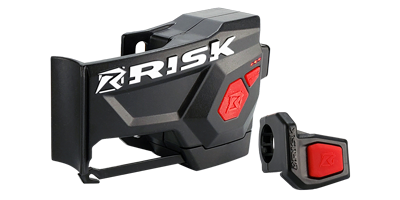
The other option that you might want to explore is the Lock-N-Load Pro from Risk Racing. This is an easier alternative to tying down a dirt bike, and it reduces the pressure on your fork seals compared with straps. There are no straps or wheel chocks to deal with. If you regularly travel with your bike, this can be a great way of keeping it secure.
Installing the Lock-N-Load Pro is a one-time job. First, you will need to load your bike into the truck. Then, with a helper holding the bike, mark where you want the mounting plate to go. Remove the bike. Next, you will need to bolt the mounting plate through the truck bed with four bolts, each with a washer and locknut underneath. Before you drill, look under the truck at the spot you marked. You don’t want to drill through the fuel tank, fuel lines, brake lines, wiring, or the spare tire, and you may need to lower the spare tire to reach the nuts.
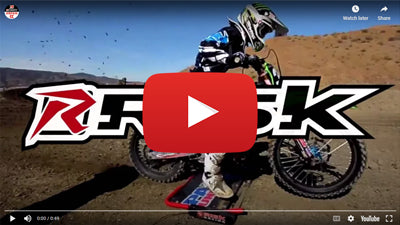
All the mounting hardware is included; you’ll just need a drill and a wrench. You will need to follow the instructions to fit it to your truck properly. The video below goes into more depth about the installation process.
Once the plate is on, you will need to add the uprights. These slide into place on the mounting plate. Then, you will need to roll the bike up and adjust the uprights to sit just over your bike’s footpegs. With the switch up and the jaws open, roll the bike in, then flip the switch down. The rubber jaws will lock down onto your bike’s footpegs, holding it in place. When you arrive, you flip the switch up to release the jaws and you can remove your bike and start riding. This can be done in a matter of seconds.
It should be noted that the Lock-N-Load Pro comes in three sizes, so pick by your bike’s footpeg height and weight. The Pro Mini is designed for smaller bikes, from the 50cc Jr to 110cc, up to a maximum weight of 200 pounds, with footpegs 8.5 to 12 inches off the ground. The Pro is best for full-size MX bikes, from 85cc to 450cc, up to a maximum weight of 270 pounds, with footpegs 12.5 to 18 inches high. The Pro HD is built for trail, MX, and enduro bikes up to 400 pounds, with footpegs 10.5 to 15.5 inches high; on a full-size MX bike you compress the suspension a little to roll it in. Measure your bike’s footpeg height before you order.

Sometimes, you will want to take multiple bikes with you on your adventures. If this is the case, it’s best to use two Lock-N-Load Pros. As long as your truck bed is big enough, you will be able to put two mounting plates side by side, one for each bike. Our FAQ says you can mount bikes right next to each other, shroud to shroud, as long as you leave 7 inches on one side or the other of each mounting plate so the uprights can slide in and out.
There is another option with straps. In this case, you will need to walk the bike onto the truck. Try to keep it as close to the edge of the bed as possible. When you reach the front, angle the handlebars. This keeps them clear of the other bike. Repeat the process with the bike on the other side, and tie each bike down on its own.
If you have done this properly, the handlebars shouldn’t be touching each other. When you are happy with the positioning, you can tie them in. Whether the tailgate closes depends on your bed length and your bikes, so see our guide on whether a dirt bike will fit in a short bed truck.
In some cases, this will leave enough space between the tires for a third bike. You can slot it down the middle. Our guide on how to load 3 dirt bikes in a truck walks through it, including why the middle bike is a lot easier on Lock-N-Loads than with straps. If you are doing this, you’ll need to pay close attention to how you tie them, and check your truck’s payload. You don’t want the handlebars to collide during the trip.

Getting your dirt bike to the track should be the easy part of the day. Strap it with four straps, soft loops on the bars, and the front wheel against the wall, and stop well short of bottoming the forks. Or skip the straps: a Lock-N-Load Pro lets you roll in, flip the switch, and go. Either way, check it again after a few miles, then go put your skills to the test.
Comments will be approved before showing up.
Be in the know! Subscribe for exclusive offers, product launches, and insider tips. Don't miss out!